The directory
Resources
A short list of Maine stroke resources I'd hand to a friend, picked by a survivor instead of a search engine. If a link is broken, or something helped you that isn't here, tell me and I'll fix it.
For younger survivors
The people who get what it's like to have a stroke decades ahead of schedule.
A weekly Zoom group for stroke survivors ages 20 to 50. Sessions are short Tuesday evenings (7:30-8:15 pm ET) with guest speakers, open conversation, and 15 minutes with a yoga instructor. Survivors with aphasia and survivors who are blind or visually impaired are specifically welcome, and you can join from anywhere in Maine.
A free monthly Zoom support group founded in 2020 to connect young stroke survivors for peer support, run by stroke survivors alongside hospital-based stroke coordinators. Meetings are the third Thursday of each month at 8pm Eastern. Sign up on the site and drop in whenever you're able.
A free virtual support group specifically for young stroke survivors, meeting on Zoom the third Monday of each month from 12 to 1pm Eastern. Caregivers are welcome, and the group is led by a licensed clinical social worker.
A nonprofit focused on the emotional side of recovery, the part where you rebuild your identity along with your abilities. Their online Community Circle connects survivors, care partners, and allies. Co-founder Debra Meyerson's book, Identity Theft: Rediscovering Ourselves After Stroke, speaks directly to figuring out who you are after stroke.
Founded by former Patriots linebacker Tedy Bruschi after his stroke at 31, this Massachusetts nonprofit supports survivors through its Comeback Assistance Program and builds community through marathon and road-race teams. One of the closest young-survivor organizations to Maine.
Bill Gasiamis survived three hemorrhagic strokes and brain surgery by age 40, and his long-running podcast features honest, in-depth conversations with survivors, many of whom had strokes young. There's a free ebook on the site, and Bill also offers paid coaching.
Will Schmierer had a stroke at 37 in 2019, got a multiple sclerosis diagnosis a couple of months later, and turned his recovery into the weekly Lovable Survivor Podcast plus newsletters about the real, day-to-day work of getting better. Made by someone living it.
Support groups & peers
Rooms with other survivors in them, in person and online.
BIAA's Maine page lists roughly 25 brain injury and stroke support groups across the state: statewide virtual groups you can join from anywhere, regional in-person and hybrid groups (Portland, Augusta, Bangor, Lewiston, and more), stroke- and aphasia-specific groups, a caregiver-only virtual group, and a Maine Youth Chat for ages 14-26. The page also links to the NeuroResource Facilitation program, which pairs you with a facilitator to help navigate life after brain injury.
- Community Stroke Support Group at New England Rehabilitation Hospital of Portland (opens in new tab)Maine
A free monthly group meeting the first Monday of each month, 5:30-6:30 pm, at 335 Brighton Ave in Portland. It's open to anyone in the community, not only former patients, and mixes education with honest conversation among survivors and caregivers. Call or email ahead to confirm the meeting date and location.
An in-person group meeting the first Thursday of each month, 11 am-12:30 pm, at 418 Payne Rd in Scarborough. It's led by a doctor of physical therapy and welcomes survivors of any kind of stroke along with caregivers. A good regular option if you're south of Portland. Contact the group ahead of your first visit to confirm the meeting time.
Enter your zip code and a mileage radius to find registered stroke support groups near you. If searching feels like too much, the Stroke Family Warmline (1-888-4-STROKE) connects you with a real person who can help, weekdays 8:30 am-5 pm Central time.
Stroke care & rehab in Maine
Where treatment and rehab happen in Maine.
Maine's only Joint Commission-certified Comprehensive Stroke Center, based in Portland, with 24/7 access to emergency stroke care, advanced procedures like clot retrieval, and a follow-up call from a stroke nurse within a week of going home. The most complex strokes in Maine are treated here.
A dedicated inpatient rehabilitation hospital in Portland offering intensive physical, occupational, and speech therapy for stroke and brain injury. Maine Medical Center's rehab physicians coordinate care with this hospital for patients who need inpatient rehab after leaving the hospital.
Board-certified rehab medicine doctors (physiatrists) who develop a personalized neuro-rehabilitation plan after stroke, starting within 24 hours of hospital admission. They coordinate care across southern Maine locations, including New England Rehabilitation Hospital of Portland.
Bangor-based stroke care for northern and eastern Maine, with a quick-response stroke team available around the clock, physical and occupational therapists on the care team, and a stroke support group to help you and your family cope after a stroke.
Outpatient rehab clinics in Bangor and Orono that handle the things stroke can leave behind: spasticity management, prosthetic and orthotic evaluation, and neuropsychology for thinking and memory changes. Physiatrists and rehab doctors oversee the care.
A Joint Commission-certified Primary Stroke Center serving the Lewiston-Auburn area, with emergency stroke treatment plus physical, occupational, and speech therapy afterward. The phone number reaches their Rehab Center.
Midcoast Maine's Joint Commission-certified Primary Stroke Center in Rockport, with emergency care, neurology follow-up, and outpatient rehabilitation therapy close to home.
Aphasia & communication
For when the words are the thing that got rewired.
Maine's own aphasia community. They run aphasia retreats, Connections get-togethers, Craftcation craft days, and the Aphasia Connections Book Club, where people with aphasia and their families can relax and talk with people who get it. Call or email to find out what's coming up.
Speech-language therapy for aphasia, apraxia, dysarthria, and other communication changes after stroke, offered at MaineHealth locations including Portland, Biddeford, Sanford, Damariscotta, and Boothbay Harbor. A doctor's referral is required, so ask at your next appointment.
The NAA's calendar of online aphasia groups you can join from anywhere in Maine, including groups for young adults with aphasia, care partner support groups, and topic chats on technology and wellness. It's a good first stop when there's no group in your town.
A 100% free online community where people with communication challenges and their care partners meet for live conversation sessions about everyday topics like travel, music, hobbies, and games. It's practice and connection rather than speech therapy. Sign up online for whichever sessions sound fun.
Free twice-monthly Zoom support groups on the 2nd and 4th Fridays (2:00-4:00 pm ET), hosted by an experienced speech-language pathologist, where survivors share their stories and support each other. Email or call the host to register and get the meeting link.
An aphasia community founded by a stroke survivor and his mother. It offers virtual Aphasia Connect support groups, informational sessions for friends and family with speech-language pathologists, communication boards and wallet cards, and a large online community.
ASHA's free directory of over 20,000 certified audiologists and speech-language pathologists who have indicated they're accepting referrals. Search on your own, whether you're starting therapy for the first time or your current fit isn't working.
Practical stuff
Work, money, rides, and paperwork. The stuff recovery runs on.
Maine's state program for finding and keeping a job with a disability. A counselor helps you figure out what work looks like now, then arranges training, job placement help, and accommodations. There's no charge for diagnostic services, vocational evaluation, counseling, or job placement assistance. Regional offices across Maine take applications.
One free, confidential call that connects you to help anywhere in Maine with heating assistance, food, housing, disability services, and more. It's available 24/7 in all languages. Dial 211 any time, or text your zip code to 898-211.
Run by and for people with disabilities, Alpha One serves all 16 Maine counties with the practical stuff: home accessibility and ramp services, adaptive driver evaluations to get you back behind the wheel, loans and grants for adaptive equipment and home modifications, personal care services, and peer support.
Free, statewide counselors who answer the scary question: what happens to my SSDI, SSI, and health coverage if I go back to work? Certified work incentives coordinators serve Maine residents on Social Security disability benefits at no cost, so you can try working without losing your safety net.
Maine's protection and advocacy agency for people with disabilities. They give free help understanding your rights, plus a clear starting point for applying for SSI or SSDI and appealing a denial. If you think you've been treated unfairly because of your disability, this is who to call.
If you have MaineCare and can't drive, which is common after stroke, you can get a ride to MaineCare-covered appointments like doctor visits and therapy, or have your ride reimbursed. Rides are booked through the transportation broker for your region at least two business days ahead. The number below reaches MaineCare Member Services, who can point you to your broker and answer questions.
Free civil legal aid focused on basic needs. They help Mainers get and keep MaineCare, SNAP food assistance, TANF, and General Assistance, including when you've been told you can't get benefits but think you should qualify. It's for people in Maine with incomes at or below 200% of the Federal Poverty Level.
For caregivers & family
Help for the people getting us through this.
Maine DHHS's front door for caregiver help: one call connects you to your local Area Agency on Aging for counseling, caregiver education, support groups, respite care, adult day services, and personal care help. Many of these programs are aimed at families caring for older adults or someone living with dementia, so fit depends on your situation. The line will point you to what fits yours.
A Family Caregiver Specialist provides free, personalized guidance on your specific situation, and the agency runs regularly scheduled caregiver support groups and educational classes. Based in Biddeford, serving southern Maine.
The Stroke Family Warmline (1-888-4-STROKE, weekdays 8:30-5 Central) connects you with someone to talk through what comes next after a loved one's stroke. The page also gathers a downloadable Caregiver's Guide to Stroke, Finances After Stroke guidance, and caregiver self-care resources.
Peer support built specifically for husbands, wives, and partners caring for a chronically ill or disabled spouse. It's a different road than caring for a parent, and one younger stroke families know well. Membership includes monthly peer support groups, 24/7 online support, webinars, and respite events.
A plain-English walkthrough of stroke caregiving covering the hospital stay, discharge planning, home safety modifications, rehabilitation options, and adjusting to long-term recovery. Their free Caregiver Help Desk will answer your individual questions.
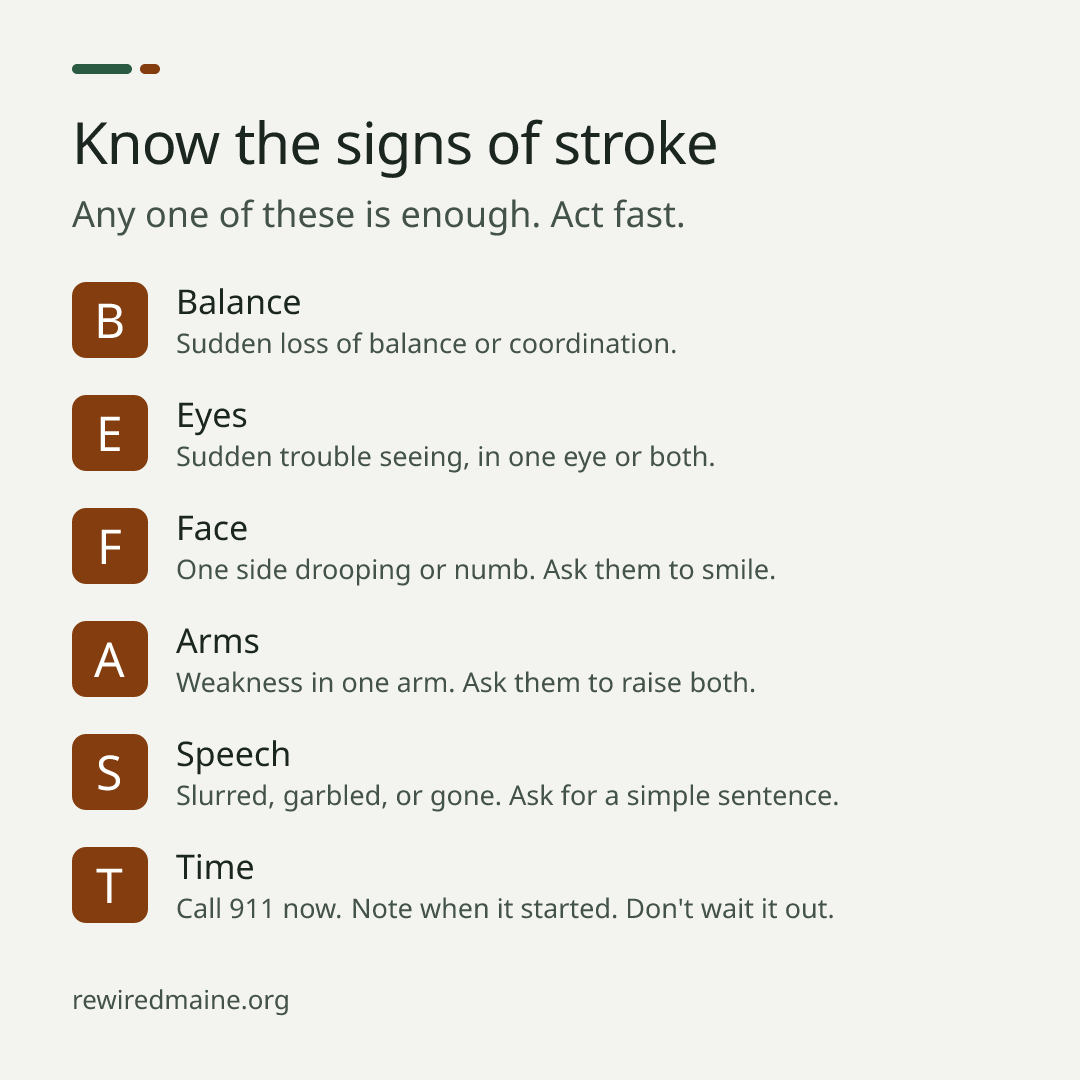
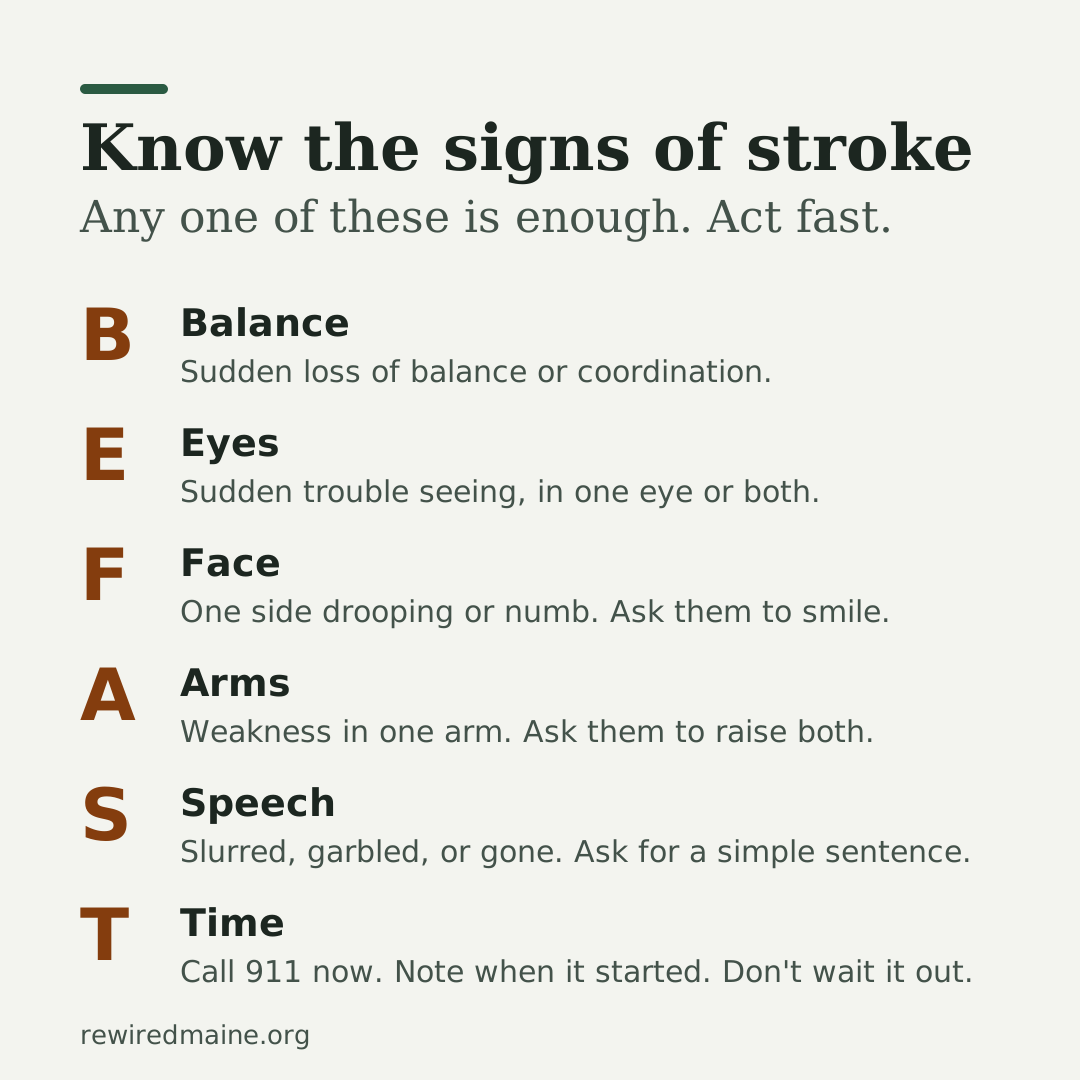
Know the signs: BE-FAST
- Balance: sudden loss of balance or coordination.
- Eyes: sudden trouble seeing, in one eye or both.
- Face: one side drooping or numb. Ask them to smile.
- Arms: weakness in one arm. Ask them to raise both.
- Speech: slurred, garbled, or gone. Ask them to repeat a simple sentence.
- Time: call 911 now. Note when symptoms started. Don't wait it out.
Download this as a shareable image and stick it on the fridge or in the break room at work. Knowing the signs saves brains. (There's also a print-quality version.)
Something missing?
This list only works if we keep it honest. If you spot a broken link or wrong info, or you know something that helped you, send it.
The suggestion box isn't wired up quite yet. For now, if you're on the email list, reply to any email. That works too.